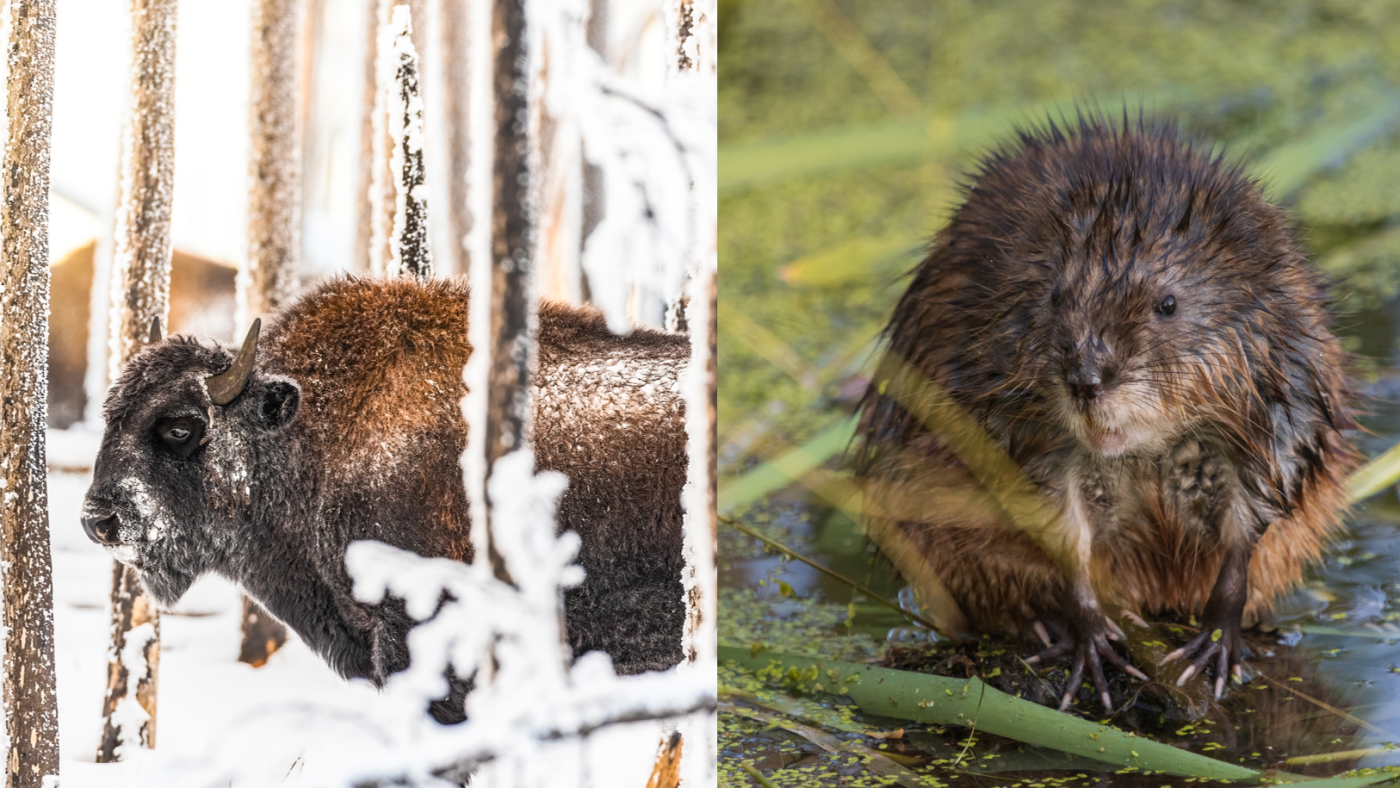
The Northwest Territories (NWT) Species at Risk Committee has assessed the biological status of two NWT species. Wood bison was reassessed as Threatened and common muskrat was assessed as Special Concern under the Species at Risk (NWT) Act.
The Species at Risk Committee conducts detailed status assessments to determine if species are in danger of disappearing from the NWT. Wood bison was last assessed in 2016. This is the first time the biological status of common muskrat has been assessed in the NWT.
SARC 2026 Species Status Assessments Summary
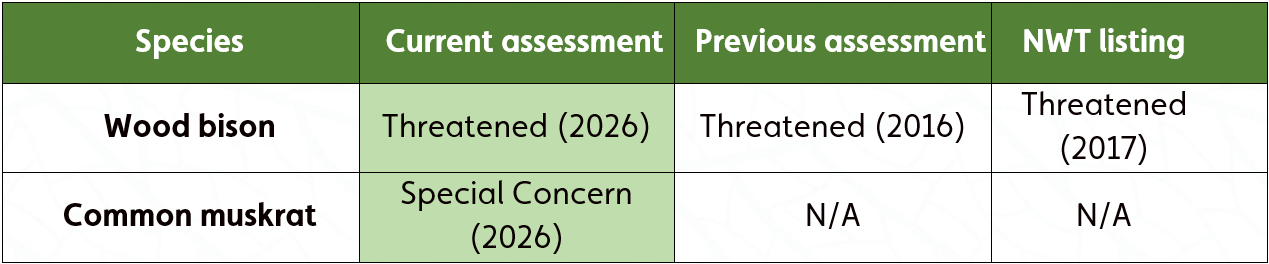
The wood bison population in the NWT is small (around 2,760 bison, not including populations in Wood Buffalo National Park) and the total number of bison has declined over the last 15 years. While some regions have seen an increase in observations and expansion of bison range, communities in the South Slave region and northern Alberta have concerns about population declines and disease.
Muskrat population trends provide insight into the health of freshwater habitats. Climate change is contributing to persistent drought conditions, which are affecting muskrat habitat across their range in the NWT. Artificial flow regulation is modifying natural seasonal changes in water levels and impacting delta ecosystems—important habitats for muskrat. Although common muskrat remains widely distributed throughout the NWT, knowledge holders have observed declines in abundance, in particular in the Mackenzie Delta, and have expressed concerns about the species and the threats it may be facing across its range.
Following the review of the status report and recent assessments of wood bison and common muskrat, SARC has made several recommendations, including:
- Encourage respectful and responsible harvest of wood bison and common muskrat to revive and support cultural connections to these species.
- Develop and implement long-term monitoring programs to gather information on trends related to common muskrat population and distribution.
- Improve coordination and sharing of information on wood bison population surveys and outcomes among government agencies, management partners, communities, and the public.
- Promote research, including documentation of Indigenous and community knowledge, to fill knowledge gaps on wood bison and common muskrat, including trends, habitat changes and threats, especially the complex effects of climate change.
- Investigate and adopt innovative and effective road safety measures to reduce vehicle-wood bison collisions.
- Continue to uphold the principles in transboundary water agreements between the NWT and adjacent jurisdictions to support the protection of all aquatic habitats.
- Encourage people to share observations of wood bison and common muskrat on iNaturalist.ca and/or report observations to WildlifeObs@gov.nt.ca.
SARC will present its assessments and recommendations to the Conference of Management Authorities (CMA) in May 2026. The CMA will then engage with NWT communities and decide if wood bison should continue to be listed as Threatened on the NWT List of Species at Risk and whether common muskrat should be added to the list as a species of Special Concern.
Photos: Wood bison - Pierre-Emmanuel Chaillon; Common muskrat - Liam Cowan
2026 status reports with assessments and recommendations:
- Status Report and Assessment of Wood Bison in the NWT (2026)
- Status Report and Assessment of Common Muskrat in the NWT (2026)
Quick facts:
- The Species at Risk (NWT) Act provides a process and tools to identify, protect and recover species at risk in the NWT.
- The NWT Species at Risk Committee (SARC) is an independent committee of experts that assesses the biological status of species at risk in the NWT.
- The Species at Risk Committee uses a dual approach to species assessment where each species is assessed using two separate sets of criteria—one based in Indigenous and community knowledge and the other in science.
- Threatened means the species is likely to become Endangered if nothing is done to reverse the factors leading to its extirpation from the NWT.
- Special Concern means a species may become Threatened or Endangered in the NWT because of a combination of biological characteristics and identified threats.
- SARC will provide its recommendations to the Conference of Management Authorities, which decides whether to add a species to the NWT List of Species at Risk and what management actions should be taken.
- A recovery strategy for wood bison in the NWT has been in place since 2018. The CMA released a progress report on actions taken under the plan in 2025.