Main Content

The Gray-headed Chickadee is a small fluffy bird with a light brown back and rusty-brown flanks. Its crown is dark brown and its throat is black. It has extensive white on the cheeks, which helps to distinguish it from the similar-looking Boreal Chickadee that has less white on the face. In northern Europe and Asia, the Gray-headed Chickadee is known as the Siberian Tit.

Weight: 11 to 14.3 g (0.4 to 0.5 oz). Length: 13.5 to 14 cm (5.3 to 5.5 in).

Report Gray-headed Chickadee sightings to ebird.org 
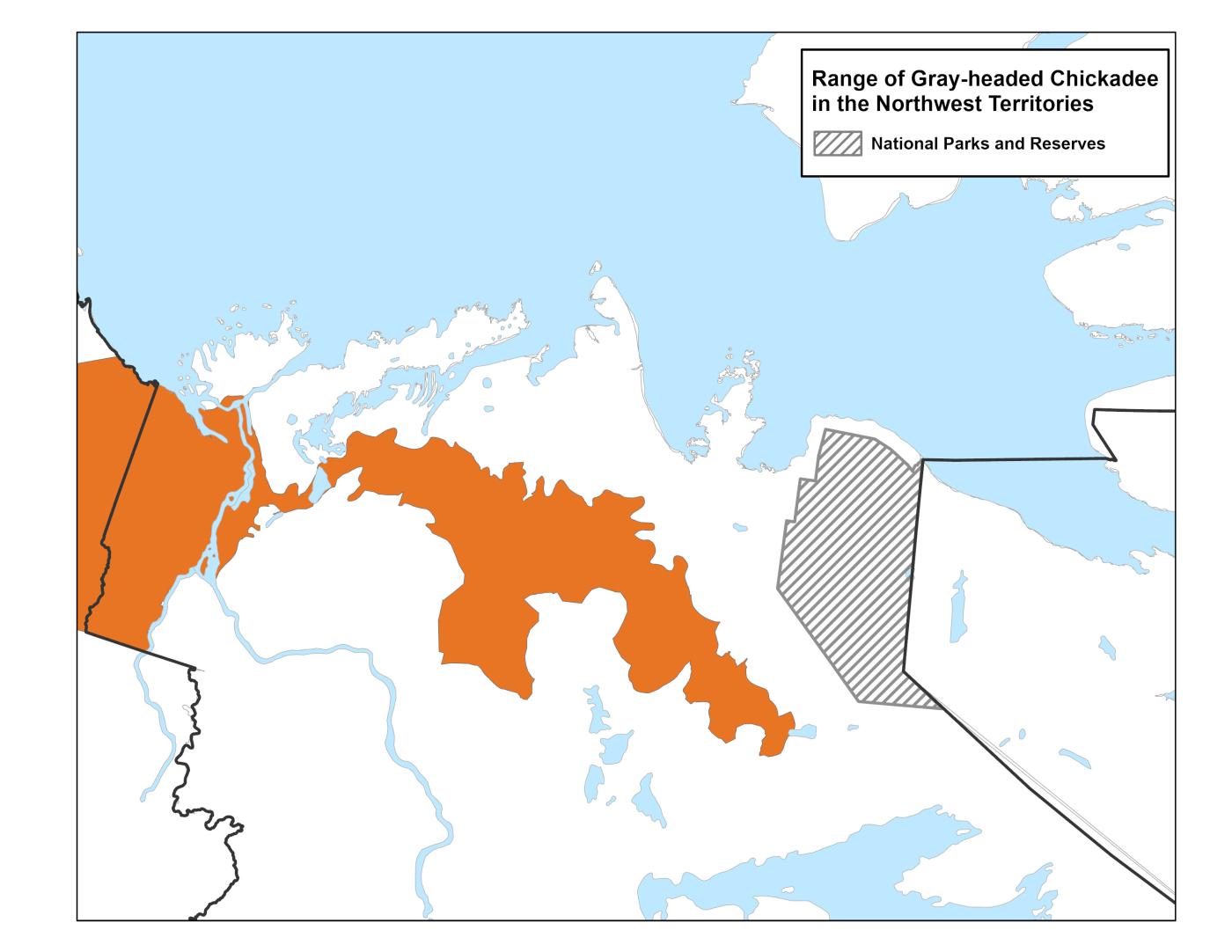
The Gray-headed Chickadee is an Arctic species that is broadly distributed across northern Europe and Asia. It has a more limited range in North America, where it has been found in Alaska, northern Yukon and northwestern Northwest Territories (NWT). Its range in North America is remote and difficult to survey but seems to be much smaller now compared to pre-2000. Although there are old records of Gray-headed Chickadee from the NWT, the most recent record is from 1990.

Range map information

Gray-headed Chickadees live at the northern edge of the boreal forest near the treeline. They eat small invertebrates like insects and spiders, as well as seeds. 

Gray-headed Chickadees nest in tree cavities. The female can excavate their own nest cavity in a patch of decaying wood in a dead or dying tree, or may renovate an existing cavity such as a woodpecker hole. Gray-headed Chickadees need mature, complex forest habitat that provides standing dead and decayed trees for nesting as well as healthy live trees for foraging.

Gray-headed Chickadees are non-migratory birds that stay in the north all year and are well-adapted to surviving long, very cold winters. They have a relatively low body temperature and extra fluffy insulating feathers, traits that probably help to limit heat loss. They cache food in hiding places like lichen and bark crevices to maintain a food supply throughout the year.

Little is known about Gray-headed Chickadees in Canada, but their population is believed to be very small and declining. Extensive surveys in northern Yukon in 2019 failed to detect the species. Between 2000 and 2023, only two observations were recorded in Canada, both in the Yukon.

Gray-headed Chickadees live year-round in remote wilderness areas where they experience little direct human disturbance. However, they are affected by climate change and severe weather, and related changes in natural processes such as freeze-thaw cycles and wildfire. 

Climate-related shifts in land cover and forest composition have been changing the availability and quality of the Gray-headed Chickadee’s northern, older boreal forest habitat. Other climate change-related impacts are suspected; for example, increasing freeze-thaw events can affect the integrity of food caches.

COSEWIC assessed Gray-headed Chickadee as Endangered in 2024. 

Gray-headed Chickadees and their nests are protected under the federal Migratory Birds Convention Act.

Area
Gwich'in Inuvialuit