Main Content

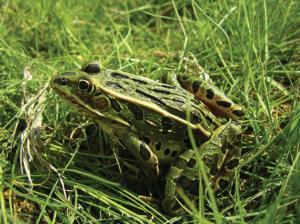
The Northern Leopard Frog is usually green, or sometimes brownish. It has dark spots surrounded by distinct light borders, and an unmarked, milky-white underside. Newly hatched tadpoles are slender and black.

The Northern Leopard Frog's call is a long drawn-out rattling snore, usually ending with several rapid short grunts.

Length: Newly hatched tadpole, 8 mm (0.3 in); Adult (snout-to-vent), 5 to 11 cm (1.9 to 4.3 in)

Report Northern Leopard Frog sightings to WildlifeObs@gov.nt.ca

Check out the Field Guide to Amphibians and Reptiles of the Northwest Territories

Northern Leopard Frogs are found in the South Slave Region of the NWT. They are uncommon in the NWT, having only been found near the Slave, Taltson, Tethul and Tazin rivers.

Northern Leopard Frogs, like most amphibians in the NWT, are at the northern-most limit of their range. The range in the NWT is not well known but there is evidence that the occupied range in the NWT may have shrunk since the late 1980s.

Range map information

The Northern Leopard Frog breeds in lakes, ponds, marshes and flooded areas of streams. Summer ranges include meadows and grasslands. Northern Leopard Frogs over-winter in the unfrozen bottoms of rivers and lakes.

The number of Northern Leopard Frogs in the NWT is unknown, but there have been reports of declines from local communities. Northern leopard frogs have declined in large parts of western Canada since 1980. The cause of population and range changes remains unknown.

Connectivity between the NWT population of Northern Leopard Frogs and populations in southern Canada is uncertain. Genetic research suggests that the NWT population is genetically distinct and geographically isolated with low genetic diversity, which is typical of small and isolated populations.

Potential threats in the Northwest Territories include: diseases (e.g. ranavirus and chytrid fungus), loss or modification of wetland habitats from human activities, accidental human-caused mortality, environmental contaminants, and increasing UV-B radiation. Multiple threats, such as disease, habitat change and UV-B radiation, can have complex and interacting effects.

In 2013, the NWT Species at Risk Committee assessed Northern Leopard Frog as Threatened in the NWT. In 2015, Northern Leopard Frog was listed as Threatened in the NWT under the territorial Species at Risk (NWT) Act. In 2025, the NWT Species at Risk Committee reassessed Northern Leopard Frog as Endangered in the NWT.

An NWT Amphibian Management Plan is available here. A progress report on implementation (2017-2021) is available here.

COSEWIC assessed Northern Leopard Frog as a species of Special Concern in Canada in 1998, 2002 and 2009. The species was listed as Special Concern in Canada under the federal Species at Risk Act (SARA) in 2005. A national management plan has been completed and is available on the federal Species at Risk Public Registry.

A guide to amphibians and reptiles of the NWT is available at www.ecc.gov.nt.ca or by contacting WildlifeObs@gov.nt.ca.

Area
South Slave
Progress Reports