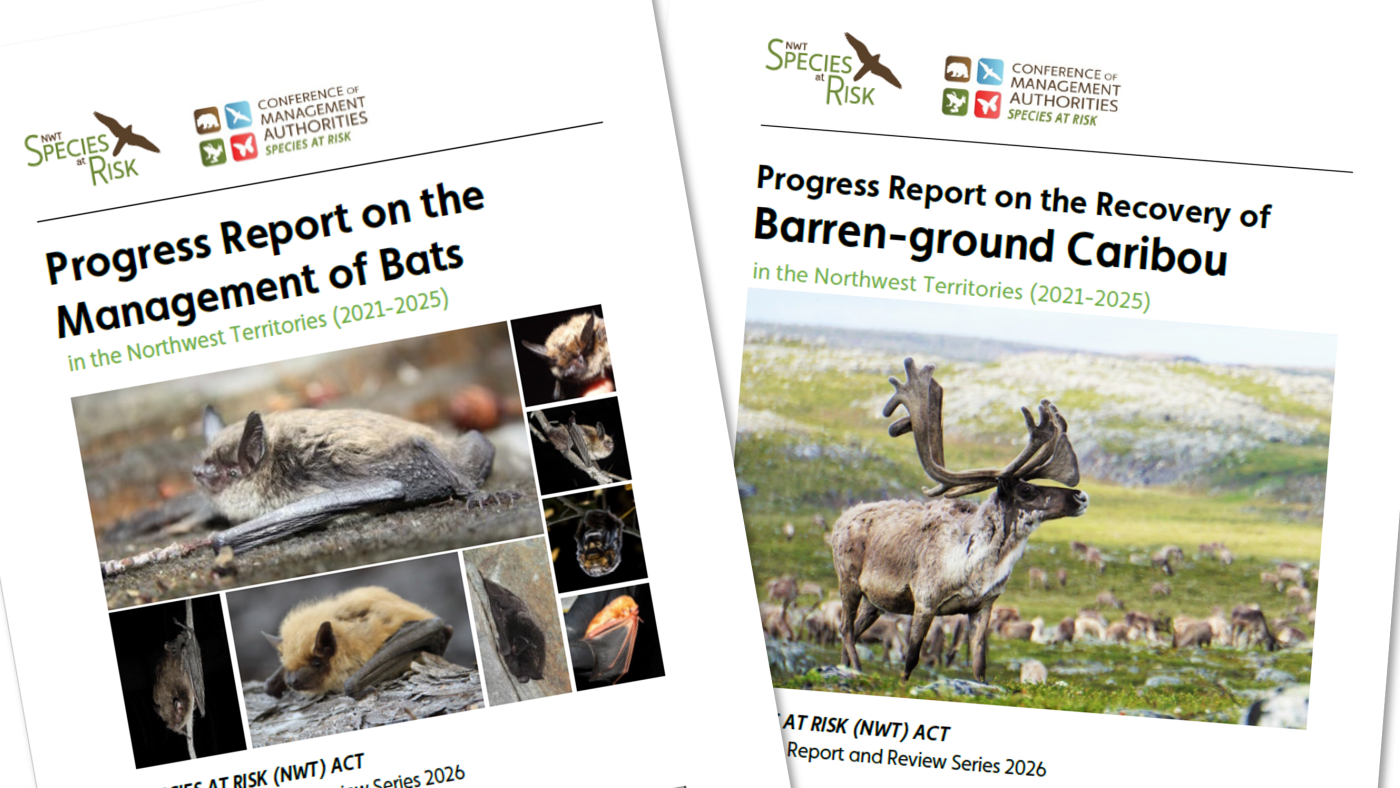
Two new reports highlight actions taken over the last five years to support the management of bats and the recovery of barren-ground caribou in the Northwest Territories (NWT).
The Progress Report on the Management of Bats in the Northwest Territories (2021-2025) and the Progress Report on the Recovery of Barren-ground Caribou in the Northwest Territories (2021-2025) were released today by the Conference of Management Authorities.
Progress reporting is required every five years for species listed under the Species at Risk (NWT) Act. These are the first progress reports for bats and barren-ground caribou in the NWT.
Progress Report on Bats
This report details key actions taken to implement the Management Plan for Bats in the Northwest Territories, including deployment of acoustic bat detectors to monitor bats across the NWT; ongoing swabbing/testing for the presence of white-nose syndrome; surveys to investigate population health, distribution and important habitat; protocols to reduce the spread of pathogens and disease; best practices to prevent unnecessary human-caused harm to bats; and efforts to increase awareness and appreciation of NWT bats.
The progress report covers all bat species in the NWT, including the two species currently listed as at-risk in the NWT. Little brown myotis and northern myotis live in the NWT year-round. The biggest threat they face is from white-nose syndrome, a deadly fungal disease that affects hibernating bats. White-nose syndrome has not yet reached the NWT, but it is getting close. Reducing other threats supports resilient bat populations and gives them the best chance of persisting during and after the arrival of white-nose syndrome.
Little brown myotis and northern myotis are listed as Special Concern in the NWT. Both species are scheduled for reassessment by the NWT Species at Risk Committee in 2027.
Progress Report on Barren-ground Caribou
Significant recovery efforts have been underway over the last two decades as many of the NWT barren-ground caribou populations declined, hitting lows between 2010 and 2020. As of 2025, two NWT herds continue to decline (Bathurst and Qamanirjuaq), one appears stable at low numbers (Bluenose-West), and four appear to be increasing (Tuktoyaktuk Peninsula, Cape Bathurst, Bluenose-East, and Beverly) although their numbers remain below historic highs.
The Porcupine caribou herd is one of the largest barren-ground caribou herds in North America. It is not included in the recovery strategy; however, for completeness, management actions for Porcupine caribou have been included in the progress report. After reaching its peak in 2017, the Porcupine caribou herd is now declining.
The progress report details key actions taken to implement the Recovery Strategy for Barren-ground Caribou (Rangifer tarandus groenlandicus) in the Northwest Territories between 2021-2025, including:
- Community-based stewardship planning;
- Regular population surveys;
- Community-based monitoring;
- Conservation of important habitats;
- Management of the impacts of human development;
- Harvest management and predator management; and
- Gathering and sharing of Indigenous knowledge and science on barren-ground caribou and the factors that influence their well-being.
Barren-ground caribou are currently listed as Threatened in the NWT. They are scheduled for reassessment by the NWT Species at Risk Committee in 2027.
Background
Bats
- There are eight bat species in the NWT: seven confirmed (little brown myotis, northern myotis, long-eared myotis, long-legged myotis, big brown bat, silver-haired bat, and hoary bat) and one suspected (eastern red bat).
- While only two bat species (little brown myotis and northern myotis) are currently listed as NWT species at risk, they share several threats in common with other NWT bats and there is considerable overlap in their management needs. As a result, a multi-species Management Plan for Bats in the Northwest Territories was completed in 2020 to address the conservation needs of all NWT bats.
- The 2021-2025 progress report includes 139 actions and approaches taken over five years to support bat management in the NWT and provides updated information about bat health and distribution.
Barren-ground Caribou
- There are nine barren-ground caribou herds that reside partially or entirely in the NWT (Porcupine, Tuktoyaktuk Peninsula, Cape Bathurst, Bluenose-West, Bluenose-East, Bathurst, Beverly, Ahiak, and Qamanirjuaq).
- As a species, barren-ground caribou (not including Porcupine caribou) was assessed in as Threatened in the NWT in 2017 and added to the NWT List of Species at Risk in 2018. Porcupine caribou were assessed separately as Not at Risk.
- The Recovery Strategy for Barren-ground Caribou (Rangifer tarandus groenlandicus) in the Northwest Territories, completed by the Conference of Management Authorities (CMA) in 2019, provides overarching guidance on barren-ground caribou conservation and recovery in the NWT.
- The 2021-2025 progress report includes nearly 350 actions and approaches taken over five years to support the recovery of barren-ground caribou in the NWT.
For more information contact:
Conference of Management Authorities
c/o NWT Species at Risk Secretariat
Phone: (867) 767-9237 ext. 53215
Email: SARA@gov.nt.ca