Main Content

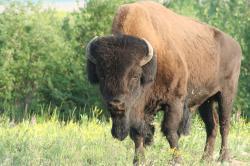
Wood Bison are the largest land mammals in North America. They are dark brown and have a massive head, a distinct beard, a shoulder hump and curved horns.

Weight: Females, 500 to 550 kg (1,100 to 1,200 lb); Males, 650 to 1,080 kg (1,430 to 2,400 lb)

Height at shoulder: 1.5 to 2.0 m (4 to 6 ft)

Report Wood Bison sightings to WildlifeObs@gov.nt.ca 
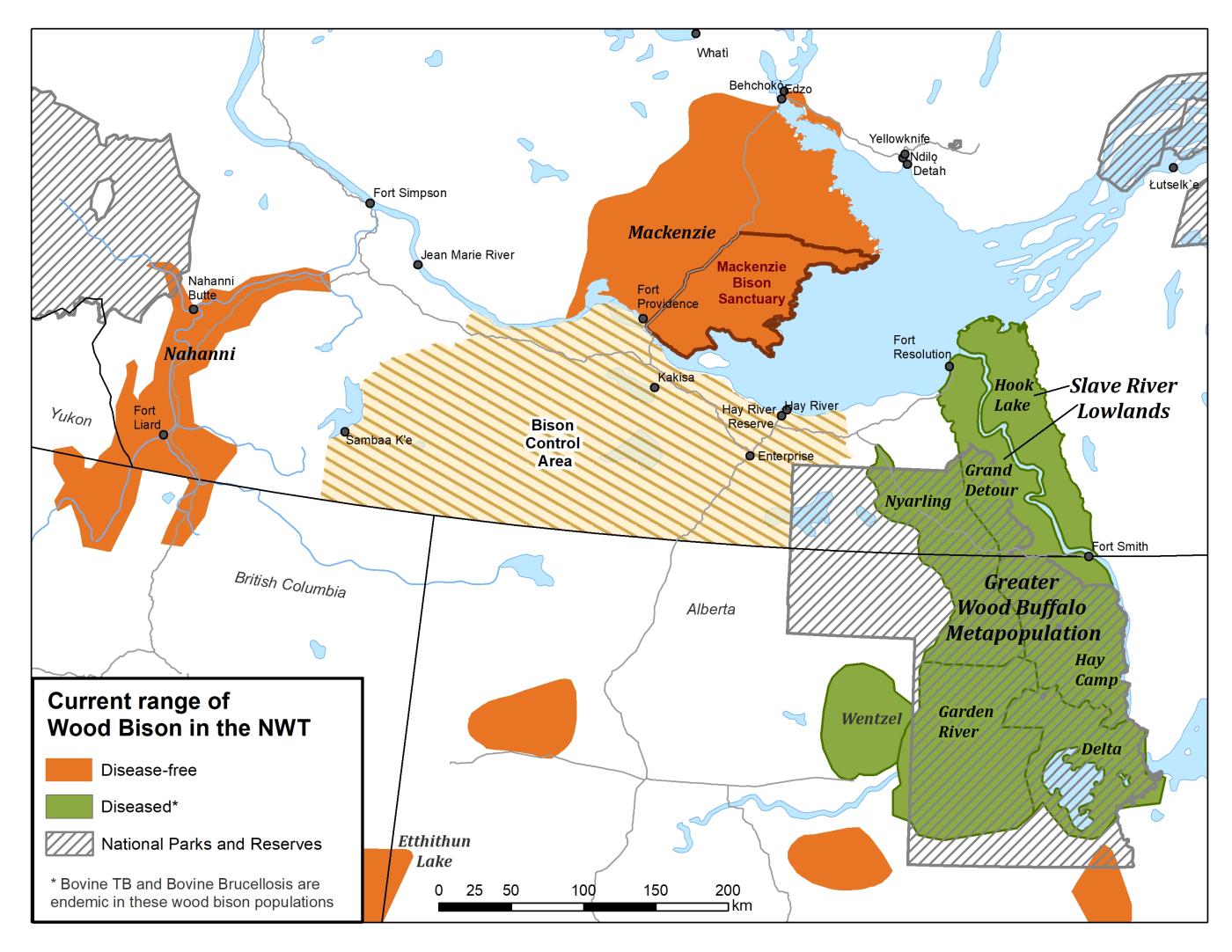
Historically, Wood Bison ranged throughout the boreal forest of northern Alberta, northeastern British Columbia, southwestern NWT, the Yukon and central Alaska.

Today, the majority of free-roaming Wood Bison populations are found in the NWT and northern Alberta. The Mackenzie population is found west of Great Slave Lake. The Nahanni population is found along the Liard River drainage.  The greater Wood Buffalo National Park population, which includes bison in the Slave River Lowlands, is found in and around Wood Buffalo National Park.

Range map information

Once on the verge of extinction due to over-hunting, Wood Bison now occur in the NWT in three free-ranging populations. The Greater Wood Buffalo metapopulation, which includes bison in the Slave River Lowlands, is infected with bovine tuberculosis and brucellosis. The Mackenzie and Nahanni populations are free of these diseases. A Bison Control Area was created to prevent the spread of bovine tuberculosis and brucellosis to the Mackenzie and Nahanni populations. All bison in the control area are presumed to be disease carriers and are therefore removed.

Typical habitat of the Slave River Lowlands and Mackenzie populations is willow savannas with grasses and sedges. Typical habitat of the Nahanni population is meadows and oxbows with sedges and horsetails. 

The Mackenzie population experienced a large decline from 2012 to 2013, due primarily to an anthrax outbreak, but seems to be recovering. In 2023, the population was estimated to be about 1,945 animals. 

The Nahanni population was estimated to be about 563 bison in 2025.

In 2024, the Slave River Lowlands population was estimated to have about 256 bison on the east and west sides of the Slave River outside of Wood Buffalo National Park. There is also a large population within the park – about 2,430 bison in 2024. These populations are smaller than in the early 2010s.

Potential threats in the Northwest Territories include:

  • Introduced bovine brucellosis and tuberculosis and the management actions that are necessary to manage these diseases
  • Naturally occurring outbreaks of anthrax
  • Vehicle collisions
  • Spring floods and falling through thin ice
  • Limited genetic diversity in disease-free populations
  • Human-bison conflicts and lack of public acceptance in some areas

In 2013, COSEWIC assessed Wood Bison as a species of Special Concern in Canada. Wood Bison previously had a status of Threatened (in 2000 and 1988) and Endangered (in 1978). Wood Bison has been listed as Threatened under the federal Species at Risk Act since 2003. A national recovery strategy for Wood Bison is available on the federal Species at Risk Public Registry

In 2016 and again in 2026, the NWT Species at Risk Committee assessed Wood Bison as Threatened in the NWT because of its small population size and recent population declines. Wood Bison has been listed as Threatened in the NWT under the Species at Risk (NWT) Act since 2017. An NWT recovery strategy for Wood Bison is available here. A progress report on its implementation (2020-2024) was published in 2025.

There are also management plans available for each of the herds at the links below.

Area
Dehcho North Slave / Tłı̨chǫ South Slave